

Lesson 2: How is Sustainable Development expressed through SDGs by the UN?
Sustainable Development Goals Report
The annual reports provide an overview of the world’s implementation efforts to date, highlighting areas of progress and where more action needs to be taken. They are prepared by the UN Department of Economic and Social Affairs, with input from international and regional organizations and the United Nations system of agencies, funds and programmes.
Five years since the adoption of the Sustainable Development Goals, the 2020 Report notes that progress had been made in some areas, such as improving maternal and child health, expanding access to electricity and increasing women’s representation in government. Yet even these advances were offset elsewhere by growing food insecurity, deterioration of the natural environment, and persistent and pervasive inequalities.
The COVID-19 pandemic has unleashed an unprecedented crisis, causing further disruption to SDG progress, with the world’s poorest and most vulnerable affected the most, including children, older people, persons with disabilities, migrants and refugees, and above all women.
Culture is the glue that holds humanity together: it is in our customs and rituals that have been passed down over the years, in our artistic expressions of the world around us, and in our revolutionary visions of the future. Despite this, there is no clear aim for culture in the UN Agenda 2030. It is NOT officially recognized as one of the three pillars of development — social, economic and environmental.
The Sustainable Development Goals present both challenges and opportunities for cultural organizations. The biggest challenge is ensuring that culture makes a meaningful contribution to the global policy agenda. The key opportunities are to demonstrate the importance of culture in society and to promote advocacy.
The European Parliament in its Report on EU action for Sustainability (2017) stresses that “culture is a transversal and cross-cutting concern and constitutes an essential resource for development, that the use of cultural resources is a fundamental way to achieve other future development goals, and that the integration of cultural factors in sustainable development policies and strategies should be done in full compliance with other international commitments, acknowledging the universality and interdependence of human rights.”
Culture is not only a field of action itself, but it is also a transversal, integral part of public policy, serving as a catalyst for sustainable development.
It is reflected across many of the goals and targets in the 2030 Agenda, such as those on sustainable cities (SDG 11), decent work (SDG 8), reduced inequalities (SDG 10), climate action (SDG 13), gender equality (SDG 5), innovation (SDG 9), and peaceful and inclusive societies (SDG 16).
It is also included in the Voluntary National Reviews submitted by countries that are invited to show their progress in the achievement of the SDGs. They are key indicators of public policy priorities and commitments at country level and draw a global picture of the ways in which countries envision a more sustainable future.
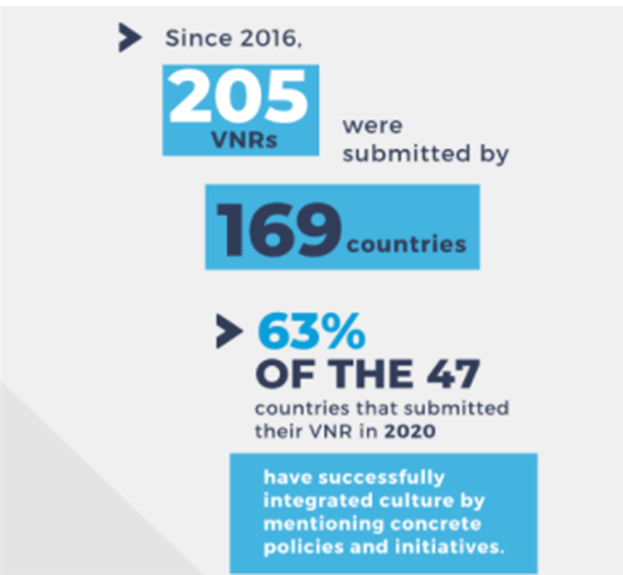
In the 205 reports submitted between 2016 and 2020, 119 made substantial references to culture in relation to all 17 SDGs, demonstrating the Member States' growing appreciation of culture's transversal position in sustainable development.
The indirect benefits of culture are reaped when development goals are implemented in a culturally aware and meaningful way. The SDGs represent a paradigm shift in how we think about development that goes beyond economic growth.
If the SDGs are grouped around the three pillars of sustainable development, then culture and innovation contribute to each of these pillars in a cross-cutting way. Sustainable development's economic, social, and environmental aspects, in turn, contribute to the preservation of cultural heritage and the cultivation of creativity.
Cultural heritage, both tangible and intangible, as well as creativity are valuable resources that must be safeguarded and handled carefully because they can act both as drivers and enablers for achieving the SDGs, when culture-forward solutions ensure the effectiveness of interventions.


Co-funded by the Erasmus+ 2021 Framework Programme of the European Union