

Lesson 2: How is Sustainable Development expressed through SDGs by the UN?
The Sustainable Development Agenda 2030
17 Goals for People and the Planet:
The Sustainable Development Goals are a universal call to action to end poverty, protect the planet and improve the lives and prospects of everyone, everywhere. The 17 Goals were adopted by all UN Member States in 2015, as part of the 2030 Agenda for Sustainable Development.
The Sustainable Development Goals are the blueprint to achieve a better and more sustainable future for all. They address the global challenges faced, including poverty, inequality, climate change, environmental degradation, peace and justice.
Agenda 2030 has five overarching themes, known as the five Ps: people, planet, prosperity, peace and partnerships, which span across the 17 SDGs.
Adopted by 193 countries, the 17 SDGs, with 169 targets and 232 indicators, came into effect in January 2016, and aim to promote economic development, social inclusion, and environmental protection. The UNCG-CSO (2017) argues that the SDGs encourage a spirit of partnership among governments, private sector, research, academia and civil society organisations, with the support of the UN.
This collaboration aims at ensuring that the right decisions are taken now to improve life for future generations in a sustainable manner.
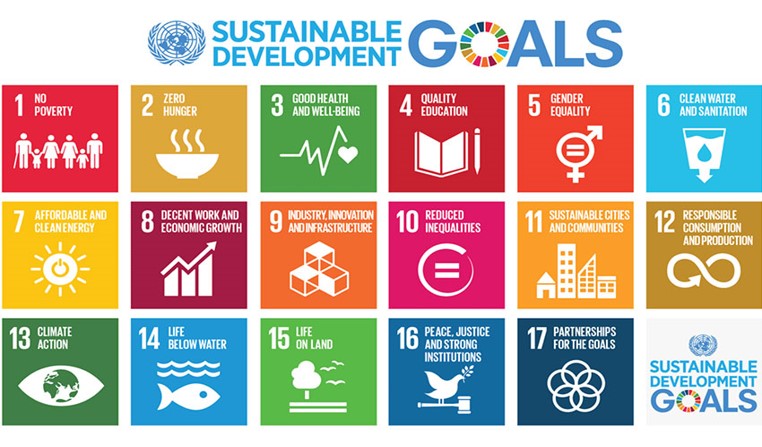
Do you know all 17 SDGs?
Goal 1: No poverty
Economic growth must be inclusive to provide sustainable jobs and promote equality.
Goal 2: Zero Hunger
The food and agriculture sector offers key solutions for development and is central for hunger and poverty eradication.
Goal 3: Good Health and Well-Being
Ensuring healthy lives and promoting the well-being for all at all ages is essential to sustainable development.
Goal 4: Quality Education
Obtaining a quality education is the foundation to improving people’s lives and sustainable development.
Goal 5: Gender Equality
Gender equality is not only a fundamental human right, but a necessary foundation for a peaceful, prosperous and sustainable world.
Goal 6: Clean Water and Sanitation
Clean, accessible water for all is an essential part of the world we want to live in.
Goal 7: Affordable and Clean Energy
Energy is central to nearly every major challenge and opportunity.
Goal 8: Decent Work and Economic Growth
Sustainable economic growth will require societies to create the conditions that allow people to have quality jobs.
Goal 9: Industry, Innovation, and Infrastructure
Investments in infrastructure are crucial to achieving sustainable development.
Goal 10: Reduced Inequalities
To reduce inequalities, policies should be universal in principle, paying attention to the needs of disadvantaged and marginalized populations.
Goal 11: Sustainable Cities and Communities
There needs to be a future in which cities provide opportunities for all, with access to basic services, energy, housing, transportation and more.
Goal 12: Responsible Consumption and Production
Responsible Production and Consumption
Goal 13: Climate Action
Climate change is a global challenge that affects everyone, everywhere.
Goal 14: Life Below Water
Careful management of this essential global resource is a key feature of a sustainable future.
Goal 15: Life on Land
Sustainably manage forests, combat desertification, halt and reverse land degradation, halt biodiversity loss
Goal 16: Peace, Justice and Strong Institutions
Access to justice for all, and building effective, accountable institutions at all levels.
Goal 17: Partnerships
Revitalize the global partnership for sustainable development.
The SDGs are confined to conflict stakeholder interests. In the case of complex problems within the SDGs, where the interests of various stakeholders’ clash, trade-offs will present governance issues. Another significant obstacle is ensuring transparency and responsibility for progress towards the SDGs.
Given the controversy over the SDGs' costs and benefits, trade-offs, complementarities, and complexities, the pertinent question is how the UN will ensure that countries adhere to the SDGs.
It is recommended that the UN:
-
consider differentiated national realities, capacities, and levels of growth, as well as national policies and priorities,
-
emphasize universality, with a country-specific approach to global targets,
-
assist countries through approaches that promote constructive involvement, collaboration, and dialogue, as well as capacity building,
-
encourage effective technology and innovation,
-
include governments, other key stakeholders including the private sector, NGOs, and civil society in the global agenda,
-
establish feedback loops to keep all responsible actors accountable for ensuring that the SDGs are enforced.


Co-funded by the Erasmus+ 2021 Framework Programme of the European Union